
Anderson County Release Photo Records
A booking photograph records appearance during a particular intake. It is not a finding of guilt, a current-custody indicator, or a current portrait. Release from the Anderson County Jail does not by itself erase the underlying photo, yet the official county site does not publish a verified released-person mugshot stream or a policy promising online publication.
Kansas law requires a record-by-record analysis. K.S.A. 45-217 excludes jail rosters and certain related entries from the definition of criminal investigation records. K.S.A. 22-4701 separately excludes release and other custody-status changes from its definition of criminal-history record information. Those exclusions can answer an overbroad closure claim, but they do not make every booking photograph categorically public. Other exemptions and redactions can still apply.
Anderson County Mugshot Search Channels
Choose a channel by custody system. The local sheriff holds the Anderson County booking record. KDOC holds state-prison images. The registry, VINE, and news each serve narrower purposes and should not be treated as interchangeable photo archives.
| Channel | Photo status | How to use it |
|---|---|---|
| Anderson County Sheriff | No verified released-person gallery | Request the existing booking photo by person and booking |
| KASPER | Can display KDOC images | Search a KDOC person; do not label it the county booking photo |
| Kansas VINE | Not a county mugshot archive | Use for one-person county-jail custody and notification |
| KBI registry | Registry images may appear | Use only to confirm statutory registry context |
| Local news | May publish an event photo | Check the date and source; a news photo may not be a mugshot |
The KBI registered-offender search is an official but distinct source.
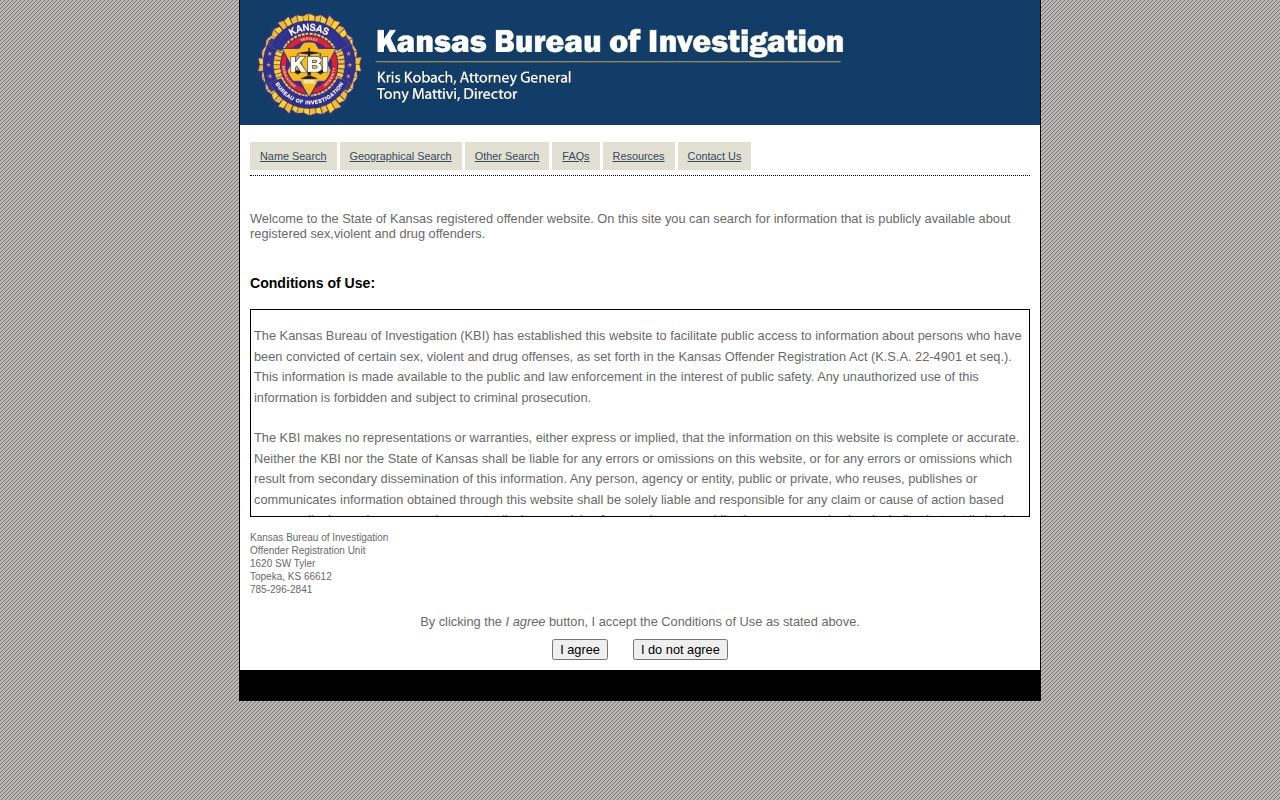
Its result can establish registry context, not the date or reason for an Anderson County jail release.
Anderson County Sheriff Photo Access
The Anderson County Sheriff page identifies the official agency, but no public rolling release-photo feed was verified. A person who has left the jail may also drop from a current roster. Absence should be stated only as “not found on the roster checked” with an access time, never translated into release.
The 24-Hour Release List explains the direct-request fallback for recent events. Ask the sheriff for the booking and release or custody-disposition record together. That combination ties the photograph to the correct intake and distinguishes community release from transport to KDOC, another county, federal custody, or another agency.
Request Anderson County Booking Photos
The Kansas Open Records Act allows a focused request for an existing record. Anderson County directs records questions through its offices, and no special online booking-photo form was verified. A precise request reduces identity errors and avoids asking the custodian to create a new compilation.
- Give the person's full name, known aliases, date of birth, booking date range, and case or booking number if known.
- Ask for the existing booking photograph plus booking and release or custody-disposition record.
- Request electronic copies and an estimate before costs are incurred.
- If anything is withheld or redacted, ask the custodian to identify the legal basis.
- Compare the response with the court order through the Anderson County release-record search.
KORA permits lawful fees and does not require creation of a record that does not exist. No fixed Anderson County photo fee was verified, so confirm cost before authorizing work.
Anderson County News Photo Limits
The Anderson County Review provides a weekly local activity layer, not an official rolling mugshot or release dataset. Published jail-roster snapshots have shown names and booking dates, but not a verified release date, reason, or photo. A combined “Booked and/or Released” count cannot be restated as a count of releases.
A dated Anderson County Review issue can preserve what was reported that week. Its cadence also creates lag. Confirm any person-level claim with the sheriff and district court. Avoid commercial mugshot publishers and removal-fee businesses; no authoritative Kansas anti-pay-to-remove rule specific enough for a controlling claim was verified.
Anderson County Expunged Photo Records
Expungement is a court process that limits access to qualifying records under a signed order. It is not safe to assume that every copy held by every custodian disappears at once. K.S.A. 21-6614 governs qualifying conviction expungement, while K.S.A. 22-2410 addresses arrest, incarceration-due-to-arrest, and related court records.
Use the exact order and ask each official custodian how it applies to the photograph at issue. If a source displays the wrong person or booking, provide the record identifier and correction proof. Do not ask for removal by claiming an unsupported statewide rule.
No Anderson County Mugshot App
No Anderson County sheriff-branded mobile app was verified. VINEMobile exists statewide, but it is a one-person custody and notification tool rather than a local mugshot gallery. It should not be described as a county release-photo feed.
For county custody changes, use Kansas VINE as corroboration and then request the sheriff's event record. For a state prisoner, use KASPER. Jurisdiction comes first because Kansas VINE does not include KDOC prison residents.
Anderson County KASPER Image Caution
KASPER detail records can display digital images for people in KDOC's scope. Its official disclaimer warns that recorded image dates may not equal the actual capture dates. A KDOC image can also come from state processing rather than the Anderson County booking.
Record the displayed status, KDOC number, image label, and access date. Then use the sheriff response to identify the local booking photo. This keeps two valid but different agency images from being merged into one event.
Verify Anderson County Mugshot Identity
Names alone are weak identifiers. Common names, spelling variants, aliases, and reused images can lead to the wrong person. Match the booking photograph to the booking number, date range, arresting agency, and case number supplied by the custodian. Date of birth can help distinguish people, but unnecessary personal data should not be republished.
A state record adds a KDOC number and state custody context. A registry result adds a statutory registration context. Neither automatically identifies the Anderson County intake image. The KBI says its registry updates every 15 minutes, depends in part on registrant-supplied information, and may not be complete. That cadence does not make it a release log.
When sources disagree, prefer the office that created the image or event. Ask the sheriff to correct a local booking mismatch. Ask KDOC about a KASPER image or label. Preserve the old and corrected record references so the nature of the error is clear without repeating more personal detail than the correction requires.
Anderson County Mugshot Release Context
A photograph does not explain how custody ended. The person may have posted bond, completed a sentence, received a court order, moved to another jail, entered KDOC custody, or remained held for another authority. Obtain the release or custody-disposition field before describing the event. If a code appears, request the agency's existing code legend.
Court records supply legal context. The journal entry, bond order, disposition, or commitment can explain why the jail acted. Kansas court access distinguishes online case information from filed documents, and some public material may be available only at a courthouse terminal. A name disappearing from a roster is less probative than those event records.
For a no-result, keep the possibilities bounded: misspelling, alias, an incorrect date, a restricted or expunged record, a different custodian, or no record in that system. Do not choose among them without evidence. A narrow official request is the next step.
Anderson County Photo Record Fields
A useful response includes more than the image file. Ask for the booking number, booking timestamp, arresting agency, charges as recorded, case number, and release or custody-disposition fields maintained with the intake. Those fields establish which event the photo depicts. Bond and charge entries can later change, so compare them with the final court record.
If the disposition says transfer, identify the receiving agency only when the public record supplies it. A KDOC commitment routes the search to KASPER. A hold for another county may explain why a person left an Anderson roster without entering the community. Do not infer the destination from the photograph or a missing roster entry.
Ask for electronic delivery and a cost estimate. The custodian may redact protected information or cite an exemption. The response, not a generalized claim about all Kansas mugshots, determines whether that Anderson County image is available.
Publication date is another key field. A weekly newspaper image, a KDOC image date, and a county booking timestamp may describe different moments. Keep each date attached to its source. An image copied without that context can wrongly imply that an old arrest or state intake is new.
If a court record has been sealed or expunged, use the signed order to contact the agency or publisher holding the copy. Do not assume that the order automatically reaches an unrelated news archive. Ask what record was removed, restricted, or corrected, and keep the response with the case documentation.
A photo request should stay tied to a legitimate records purpose such as confirming the correct release event, reconnecting with the right person, or documenting a court matter. Use the least personal detail needed. The final check is always the originating record, since a copied image can lose its caption, date, booking number, and agency attribution as it moves between sources.