
KDOC Release Paths After Anderson
A commitment from Anderson County District Court moves a person from local jail custody into the statewide KDOC system. That movement is a transfer, not release to the community. Once KDOC accepts the person, KASPER becomes the appropriate public locator. The Anderson County jail record documents the end of the local booking, while the court commitment and KDOC record explain why custody continued.
Later, a person may leave a KDOC institution on parole, postrelease supervision, conditional release, maximum sentence, or sentence discharge, depending on the sentence structure and governing law. Parole and postrelease place the person outside prison under KDOC supervision. Discharge is stronger and means the KDOC sentence obligation has ended. A record should preserve the agency's exact term instead of converting every community status into “free.”
County exit and prison release are separate events. An Anderson jail transfer to KDOC does not prove community release.
Search KDOC Anderson Release Status
KASPER is the Kansas Adult Supervised Population Electronic Repository. It covers persons and cases associated with programs operated or funded by KDOC. It is not a full Kansas criminal-history system. Its proper role here is to locate an Anderson County person who entered state custody and read the current institutional, supervision, release, or discharge context that the record actually provides.
- Open the official KASPER search and read the disclaimer.
- Search by KDOC number when available, or use the most specific name information offered.
- Match identity through age or date information, conviction county, case associations, and photograph with care.
- Open the detail and record the literal status, location or supervision context, and date label.
- Save the access date because KASPER is updated each working day.
A same-day move may not yet appear. KASPER's disclaimer says the system updates on working days and can lag a live change. The broader Anderson County release search shows when the sheriff or court record should be compared with KDOC.
KDOC Release Record Fields
The live detail may include identity, KDOC number, status, location or supervision context, convictions, case associations, photographs, and dates. Field availability varies. Report the literal label. Kansas uses sentence concepts such as guidelines release date, conditional release date, parole eligibility, postrelease supervision, and sentence discharge or maximum date. They are not interchangeable.
| KDOC field | How to read it |
|---|---|
| Institution or custody status | The person remains in the state correctional system |
| Parole | Outside prison under KDOC supervision for an eligible sentence |
| Postrelease supervision | Community supervision following the prison portion of a determinate sentence |
| Discharge or maximum date | End of the stated KDOC sentence obligation |
| Guidelines or conditional date | A sentence-specific date that may depend on credits and rules |
KDOC cautions that digital-image dates may reflect when an image entered the database rather than when it was taken. The detail is also limited to KDOC-associated people and cases. It should not be described as a complete record of every Kansas court or custody event.
KDOC Records and Computation
Begin with KASPER for a public status record. For a disputed public entry, the disclaimer directs written accuracy comments to kdoc_pub@ks.gov. For a specific release-date calculation, the KDOC locating FAQ directs questions to Sentence Computation at 785-296-3317. That unit can address person-specific sentence computation more accurately than a percentage guessed from the offense name.
Kansas Department of Corrections
Public locator: KASPER
Sentence Computation: 785-296-3317
KASPER accuracy comments: kdoc_pub@ks.gov
Records requests: KDOC records-request portal
Describe the existing record sought and identify the resident by name and KDOC number when known. Public status or movement records differ from confidential medical, victim, security, treatment, and supervision information. A records request does not require the agency to create a custom explanation.
The official KDOC records portal provides the department's request route.
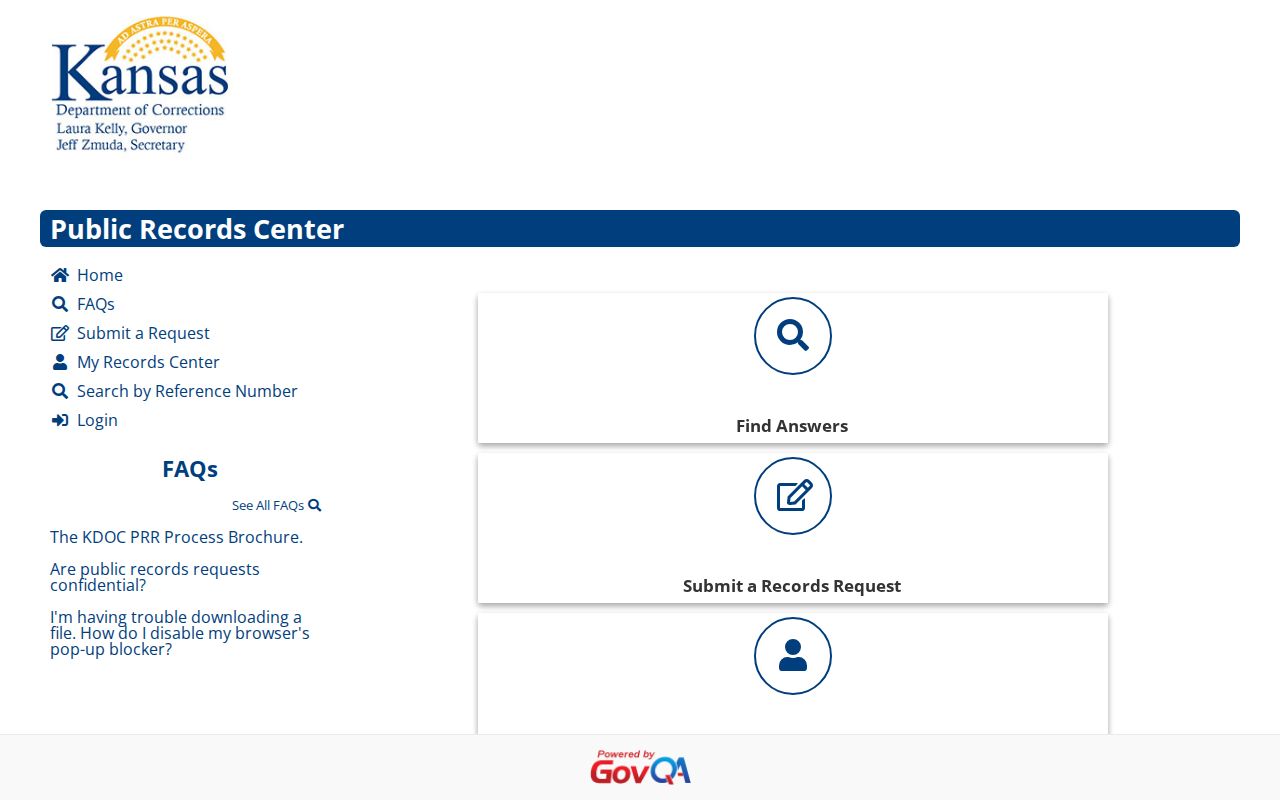
The captured portal supports formal record access; it does not replace KASPER for a current public status check.
KDOC Dates Can Change
KDOC's locating FAQ warns that release dates can change with good-time and program-credit earnings or forfeitures. K.S.A. 21-6821 provides an ordinary maximum good-time allowance of 15 percent of the prison portion for many covered modern sentences, while specified categories may earn up to 20 percent. Credits must be earned and retained. Neither percentage promises a date.
Program credits, jail credit, court corrections, new sentences, holds, and credit loss can affect computation. Older pre-guidelines sentences use other concepts and rules. K.S.A. 22-3717 also contains date- and offense-specific exceptions, including sentences with mandatory minimum terms. A public page should never calculate one person's release solely from a charge label or the common “85 percent” shorthand.
A projected date is the agency's current calculation. An actual release date records an event. Sentence discharge marks the end of the stated KDOC obligation. Keep all three concepts separate.
KDOC Parole and Postrelease
The Prisoner Review Board handles release decisions for eligible older or indeterminate sentence structures. A scheduled hearing or public-comment session is not proof of physical release. Board action may be parole, continue, or pass, and release can depend on an approved plan. No current public person-by-person decision search was verified. KASPER after the decision or a public records request is the appropriate proof route.
Modern determinate sentences generally lead to mandatory postrelease supervision after the prison portion ends under the governing rules. KDOC Parole Services then supervises the community period. Anderson County is routed through the Lawrence Parole Office service path. KASPER status and the office directory can confirm the public context, but personal schedules and detailed conditions may remain confidential.
KDOC Modernization Gap
KASPER has a distinctive limit with direct Anderson County consequences. Its disclaimer says community-corrections probation events after April 21, 2021 cannot currently display during modernization. A timeline that ends near that date is not proof that later supervision events never occurred. Use the Anderson County court docket and Fourth Judicial District Community Corrections for modern probation verification.
Kansas VINE is also the wrong system for a KDOC resident. The Attorney General describes VINE as a county-jail custody and notification service. It does not include people housed in KDOC state prisons. A VINE no-result after an Anderson jail transfer may simply mean the person moved beyond VINE's county-jail scope.
For final verification, pair the records by event. The Anderson sheriff record proves the local booking ended. The court commitment explains entry into state custody. KASPER and KDOC records describe the later state status. Parole Services confirms community supervision, and a discharge record documents the end of the KDOC sentence. Preserve exact labels and dates, note the access time, and ask the originating office to resolve any conflict.