
Anderson County Projected Versus Actual
A projected date is a calculation based on the sentence record, credits, and legal rules known at that time. KDOC uses the precise phrase “anticipated guidelines release date” in its public-record field inventory. Anticipated means prospective. The field must not be restated as an actual departure date.
A pretrial detainee usually has no sentence-based date. Release may depend on bond, a court order, dismissal, transfer, or later sentencing. For a sentenced county-jail inmate, the signed journal entry, jail credit, and sheriff's computation matter. For a state prisoner, KASPER and KDOC Sentence Computation are the proper channels.
Find Anderson County Projected Release
Start with the institution that now holds the person. The KASPER offender search is for KDOC custody and supervision, not a general Anderson County jail roster. Search fields include name, alias, KDOC number, date of birth, conviction county, and parole-supervision county.
- Confirm whether custody is county, state, federal, or a transfer. Use the Anderson County released inmate lookup if that is unclear.
- For KDOC, search KASPER and copy the exact date field, status, and access date.
- For county custody, ask the sheriff for the computed date and ask the district court for the sentence journal entry.
- For a future hearing, treat the Prisoner Review Board month as procedure, not a release promise.
- Verify a changed or disputed KDOC calculation with Sentence Computation at 785-296-3317.
The KDOC locating FAQ warns that projected dates can change. A no-result can reflect an identifier problem, another custodian, a delay, or a restricted record. It is not proof of release.
Anderson County State Good Time
Kansas good time is earned sentence credit, not an automatic discount. Under K.S.A. 21-6821, many covered crimes committed on or after July 1, 1993 carry a maximum ordinary allowance of 15 percent of the prison portion. That produces the common 85-percent shorthand. Some specified lower-severity and date categories may allow up to 20 percent. Credits must be earned and retained, and they may be forfeited.
The same statute provides limited program credit for eligible groups and designated programs. The present statutory maximum is 120 days, with exclusions. Earlier materials may show an older cap. The current statute and person-specific KDOC calculation control.
Pre-guidelines sentences use different rules. K.S.A. 22-3725 applies to crimes before July 1, 1993 and uses its own table. Indeterminate terms also separate parole eligibility, conditional release, maximum release, and Board suitability. Those terms cannot be collapsed into one projected date.
Why Anderson County Dates Change
A valid estimate can move as the legal and administrative record changes. Preserve both the old and new label when comparing sources.
| Factor | Possible effect | Record to check |
|---|---|---|
| Good-time award or forfeiture | Moves the anticipated prison date | KDOC computation and disciplinary record |
| Program credit | May reduce eligible prison time within statutory limits | KDOC sentence computation |
| Corrected journal entry | Changes sentence terms or jail credit | Fourth Judicial District court file |
| New case or detainer | May prevent community departure after one custody basis ends | Sheriff disposition and receiving-agency record |
| Parole action | Grant, pass, or continue affects an eligible indeterminate case | PRB decision and later KASPER status |
| Revocation or absconder time | Can change custody and sentence dates | Court or KDOC supervision record |
K.S.A. 22-3717 contains major exceptions. Life without parole has no parole date, and listed offenses can require special minimum terms. Modern determinate sentences generally lead to postrelease supervision after the prison portion rather than a discretionary parole hearing.
Confirm Anderson County Actual Release
Use the record closest to the event. The sheriff's release entry documents physical processing from the county jail. A court order documents legal authorization. A KDOC movement record and current KASPER status document a state-prison change. These timestamps may differ without being wrong.
Kansas VINE can provide a county-jail custody notification, but the Attorney General says it excludes KDOC prison residents. Use the VINELink Check for the local-jail path, then obtain the sheriff record for the disposition. For KDOC, verify the status and literal date through KASPER or Sentence Computation.
The Kansas parole and postrelease statute is a useful official reference for the distinctions behind the displayed dates.
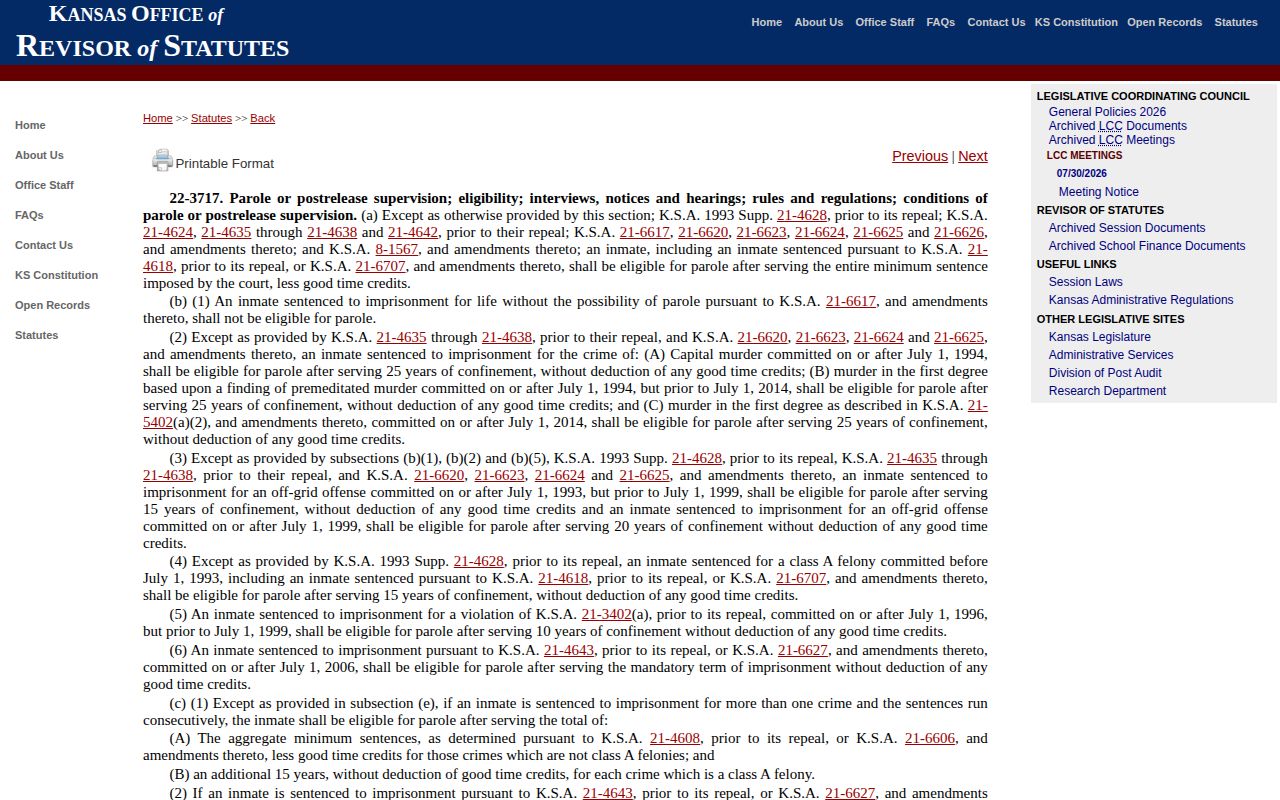
Its exceptions show why a simple percentage cannot replace the person-specific sentence record.
Anderson County Jail Date Limits
No published Anderson County jail good-time or weekend-release policy was verified. Therefore, the state-prison 85-percent shorthand must not be applied to a local jail sentence. The sentencing order, awarded jail credit, sheriff's implementation, and governing law control.
Ask for the computed release date and its legal basis. A narrow request should name the person, case, booking range, and exact field sought. If the response uses a code, ask for the existing code legend. Do not ask the custodian to create a new calculation that is not already maintained.
Every date should be labeled as projected, eligibility, conditional release, actual prison release, supervision end, or sentence discharge. Access dates matter because the underlying credit and custody facts can change.
Anderson County Release Date Labels
Kansas records contain several dates that answer different questions. Parole eligibility marks when an eligible indeterminate case may reach Board review. It is not a promise of parole. Conditional release and maximum release arise from their own statutory framework. An anticipated guidelines release date is a credit-sensitive estimate for a covered sentence. Sentence expiration or discharge describes the end of the remaining KDOC obligation, which may occur after prison release because supervision can continue in the community.
The Prisoner Review Board process also separates determinate and indeterminate terms. For a determinate sentence, postrelease begins after the adjusted prison portion, and the Board sets conditions rather than choosing whether ordinary release occurs. For an eligible indeterminate case, the Board may parole, continue the matter, or pass it for a stated period. Even a grant can depend on an approved plan and other steps.
Monthly public-comment material lists a hearing-eligibility month and may name a later possible-release month. Anderson as the county of conviction does not prove that the person lives in or will return to Anderson County. No public person-by-person decision search was verified. Later KASPER status or a person-specific Board record provides stronger proof.
Anderson County Holds and Transfers
One sentence can end while another lawful custody basis remains. A detainer is a request from another authority for notice or temporary custody. A court can also order transport to KDOC, another county, or federal custody. In those cases, an Anderson County jail exit is a transfer, not release to the community.
Compare the sheriff's disposition with the receiving agency's record. If the event says KDOC transport, use KASPER. If it identifies federal custody, use the Bureau of Prisons locator and the federal docket. For a possible immigration transfer, use the ICE locator and official contact route, while avoiding assumptions because no Anderson-specific ICE contract or practice was verified.
Do not force different agency timestamps into one date. A court order can authorize release, the jail entry can document later physical processing, and a receiving record can begin after transport. State what each record proves. If the court ordered release but the sheriff has not confirmed departure, keep that timing unresolved.
Anderson County Sentence Computation Records
KDOC public records can include the controlling and individual sentences, sentence-begins date, parole eligibility, conditional release, expiration, movements, and anticipated guidelines release date. These fields belong together. A single date without its label or sentence context invites error, especially when consecutive or concurrent terms, jail credit, or more than one case is involved.
Ask Sentence Computation about the person-specific calculation rather than asking a general office to predict a date from a charge. Supply the resident's name, KDOC number, and known sentence or case identifiers. Request the releasable computation, applicable credits and forfeitures, and the meaning of the displayed label. The KDOC FAQ gives 785-296-3317 for specific questions.
A correction can be legitimate. Courts may amend a journal entry, KDOC may receive new credit information, or a disciplinary or program event may affect credit. Note the date of the answer and do not preserve an earlier estimate as if it were still current.
Anderson County Sentence Rule Boundaries
Kansas changed sentencing systems over time. Current guidelines calculations must not be applied to a pre-guidelines offense. K.S.A. 22-3725 contains a separate table for crimes before July 1, 1993 and generally allows one-half credit for terms of at least two years under its conditions. Those cases use minimum, maximum, eligibility, conditional-release, and Board concepts that differ from a modern determinate term.
Special sentences also resist shorthand. K.S.A. 22-3717 includes listed capital, first-degree-murder, off-grid, and date-specific provisions with mandatory minimum terms. Life without parole has no parole date. The signed judgment and the law in effect for the offense must be read together.
For a modern on-grid determinate case, completion of the adjusted prison portion generally starts mandatory postrelease supervision. It does not necessarily end the sentence. State-prison departure, supervision end, and sentence discharge should appear as separate events in any Anderson County release chronology.
Release notifications also have limits. Kansas VINE covers adults in county jails, not KDOC prison residents. A county notification can flag a custody change, but the sheriff record should confirm the disposition. For state custody, use KASPER and KDOC confirmation. For both paths, a notification time may differ from the physical movement time because data transmission follows agency processing.
When reporting an estimate, state the source, field label, and access date in the same sentence. If the date later moves, describe the change without guessing why. Obtain the computation or new order before attributing the cause.