
Federal Release Paths from Anderson
A federal writ, hold, charge, or sentence can move a person from Anderson County Jail to the U.S. Marshals Service, a contract detention site, or the Federal Bureau of Prisons. The local jail may record that movement as a release from its booking. It is still a transfer of custody when a federal authority receives the person. The sheriff record should identify the disposition and receiving agency when that information is public.
BOP generally manages sentenced federal prisoners. The U.S. Marshals Service commonly transports and holds federal pretrial prisoners and people moving between court and confinement. ICE is a separate immigration custodian. Each has a different locator and record scope. No BOP prison, ICE detention facility, or Anderson-specific ICE contract was confirmed within Anderson County.
A federal transfer is not community release. Confirm the receiving authority before interpreting an Anderson County jail exit.
Search Federal BOP Release Records
Use the official BOP Inmate Locator for a person who served or is serving a federal sentence. A federal register number is the strongest search key. The locator also permits a name search with race, sex, and age filters. Match the record carefully because similar names can produce several results.
- Search by BOP, DCDC, FBI, or INS number when known.
- Otherwise enter the full name and available identity filters.
- Compare name, register number, age, race, and sex.
- Read the location and release-date fields exactly as displayed.
- Use the federal docket or agency contact for context the locator does not provide.
BOP says its locator generally includes federal inmate records from 1982 forward. Older federal records may require the National Archives. The Anderson County release search remains the correct guide for a separate local booking episode.
BOP Released Status Meaning
BOP's public result fields can include name, register number, age, race, sex, release date, and location. A past release date combined with a location of “RELEASED” means the BOP record says the person is no longer in BOP custody. It does not prove that every form of custody or supervision ended.
| BOP wording | Bounded meaning |
|---|---|
| RELEASED with date | The person left BOP custody as recorded on that date |
| Not in BOP custody | BOP is not the present custodian; another status may still apply |
| UNKNOWN | The confinement term is not determined in the locator |
| IN TRANSIT | Movement is underway or not yet resolved in the public record |
A released BOP result does not exclude federal supervised release, a new state or local custody event, civil immigration detention, or another authority. “Not in BOP custody” is similarly narrow. Preserve the exact phrase and access date. Do not translate it into an unsupported present location.
Federal BOP Records Contact
The national locator is the first public route. Its record explanation defines the fields and limits. If a federal release date or movement requires durable proof, use the responsible BOP records process and federal court docket. A docket can explain the sentence, order, modification, or supervision term, while the locator shows the BOP custody result.
Federal Bureau of Prisons
Public search: BOP Inmate Locator
Coverage: Federal inmate records generally from 1982 forward
Older records: Follow the BOP route to the National Archives
Victim Notification System: 1-866-365-4986 for eligible enrolled victims
The official locator explanation is shown below.
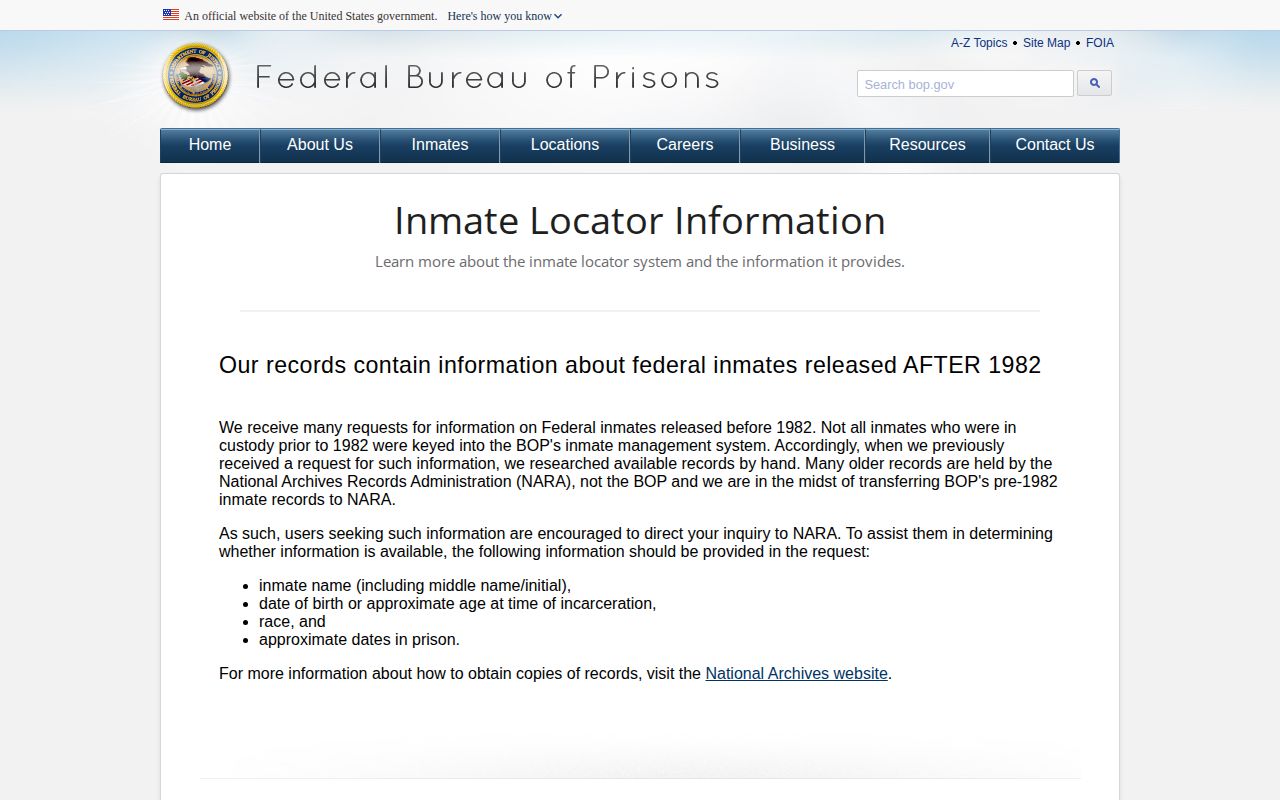
The screenshot documents locator scope and interpretation, not any selected person's status.
Federal Custody Outside BOP
The U.S. Marshals Service handles federal prisoners in court-related detention and transport, often through contract facilities. Research did not identify a public USMS historical release locator comparable to BOP. A person can therefore be absent from BOP yet remain in USMS custody or be awaiting movement. Use the federal court docket, defense counsel, court clerk, or responsible federal agency for that context.
“IN TRANSIT” can be especially uncertain because transport, court action, and later release may not appear at the same time. Do not announce release from an old locator capture. Ask the agency that created the movement record, and preserve the exact time and label of each source.
ICE Transfers from Anderson Custody
ICE is not BOP. If the Anderson sheriff disposition says release to ICE, the event is a transfer rather than release into the community. The ICE Online Detainee Locator has two paths: an A-number search with country of birth, or a biographical search using exact first and last name, country of birth, and optional date of birth.
ICE says its locator includes current detainees and people released from ICE custody within the prior 60 days, and it does not search children under 18. It is not a durable historical archive. The Detention Reporting and Information Line is 1-888-351-4024, Monday through Friday excluding holidays, 8 a.m. to 8 p.m. Eastern. It offers language help and basic case information.
A detainer requests advance notice and custody for up to 48 hours beyond ordinary release so DHS can assume custody. No Anderson-specific detention contract or practice was verified. Present this only as a possible path when a person-specific sheriff record supports it.
Federal Release Notification Limits
Eligible enrolled victims may receive information through BOP's Victim Notification System. BOP states that the service can provide a release date, destination city and state, and the applicable U.S. Probation office before sentence completion. It is restricted to eligible participants and is not a general public locator. It is also unrelated to Kansas VINE, which covers county-jail custody changes and excludes KDOC prison residents.
The BOP victim resources page explains this separate notification channel.
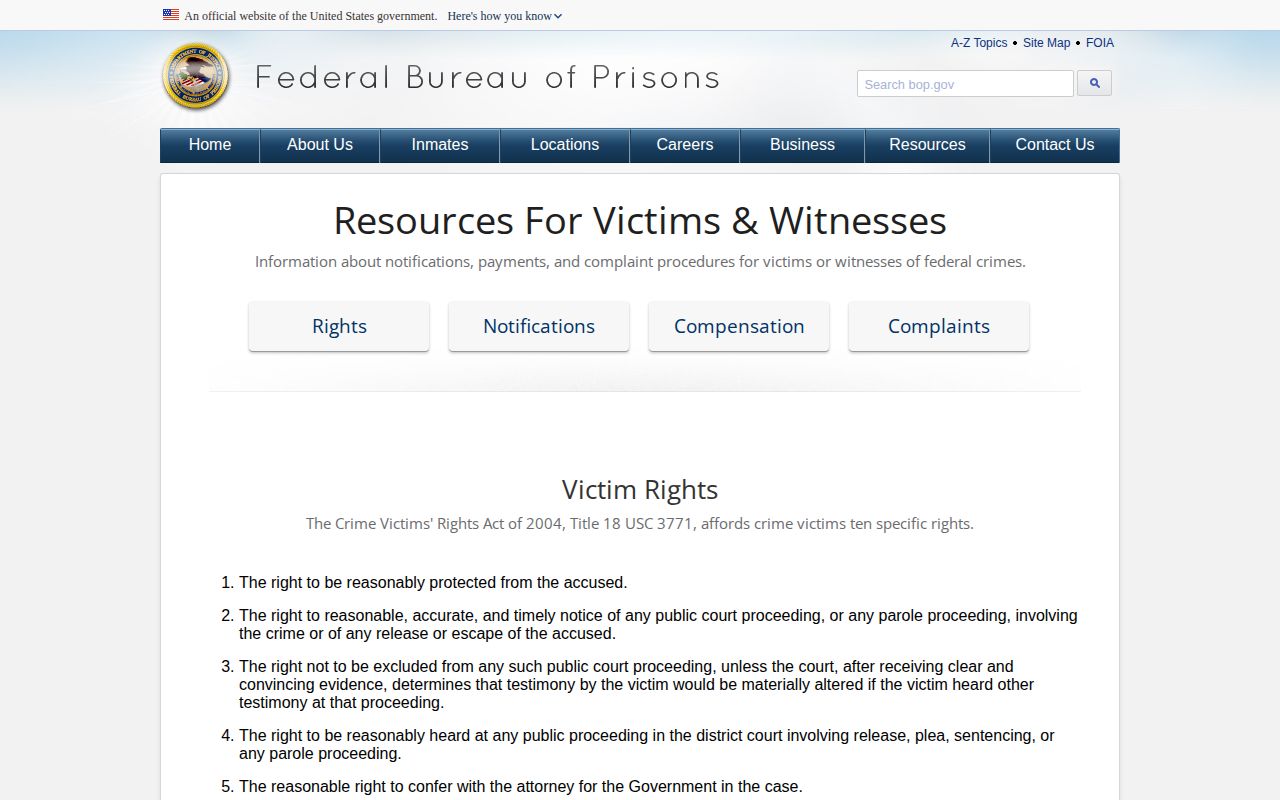
The service adds notice for enrolled users but does not replace a public locator result or certified federal record.
For a complete verification chain, begin with the Anderson sheriff record if the person left local custody. Use the receiving federal agency to confirm continued detention. Read the BOP locator for a sentenced federal record, the federal docket for judicial action, and ICE only when an immigration transfer is documented. Different systems may show different dates because an order, jail movement, transport, prison intake, and final release are distinct events. Preserve each agency's wording and verify current status at the source.