
Anderson Court Release Evidence
Anderson County is served by the Fourth Judicial District. Its district-court file can preserve the legal reason for a jail exit long after a current roster changes. A bond order may authorize release while a case remains pending. A dismissal can end a charge, though another case or hold may remain. A sentencing journal entry may impose probation, time served, or commitment to the Kansas Department of Corrections. A revocation order can send a person back into custody.
The court record and jail record are complementary. The judge's order states legal authority. The Anderson County Sheriff's movement entry records physical processing and the destination or disposition when maintained. A court order issued in the morning does not prove that the jail completed release at that same moment. Conversely, a transfer entry does not explain the underlying sentence unless the court file is also reviewed.
Read the event, not just the docket heading. A hearing date or filed motion is not proof that release was granted or completed.
Search Anderson Court Case Records
Begin at the Kansas District Court Public Access Portal. Use the Smart Search controls offered on the live screen. A case number is the best key because common names can return unrelated matters. Select or confirm Anderson County, compare the party name, case type, attorneys, judge, and hearing history, then open the public documents that are actually available.
- Search the exact case number when it is known.
- Otherwise search the full name and narrow to Anderson County.
- Confirm the case identity before reading an event.
- Locate bond, disposition, journal-entry, sentence, probation, or commitment documents.
- Compare the order with the sheriff's physical release or transfer record.
Kansas Courts distinguishes “case information” from “court records.” Basic portal data can show parties, attorneys, judge, type, and hearings even when the filed document is not downloadable. The official district-court records guidance says public material absent online may still be available through a courthouse public-access computer. The home page's Anderson County release search explains the parallel sheriff and custody channels.
The official Kansas eCourt overview shows the statewide system that supports this Anderson County record path.
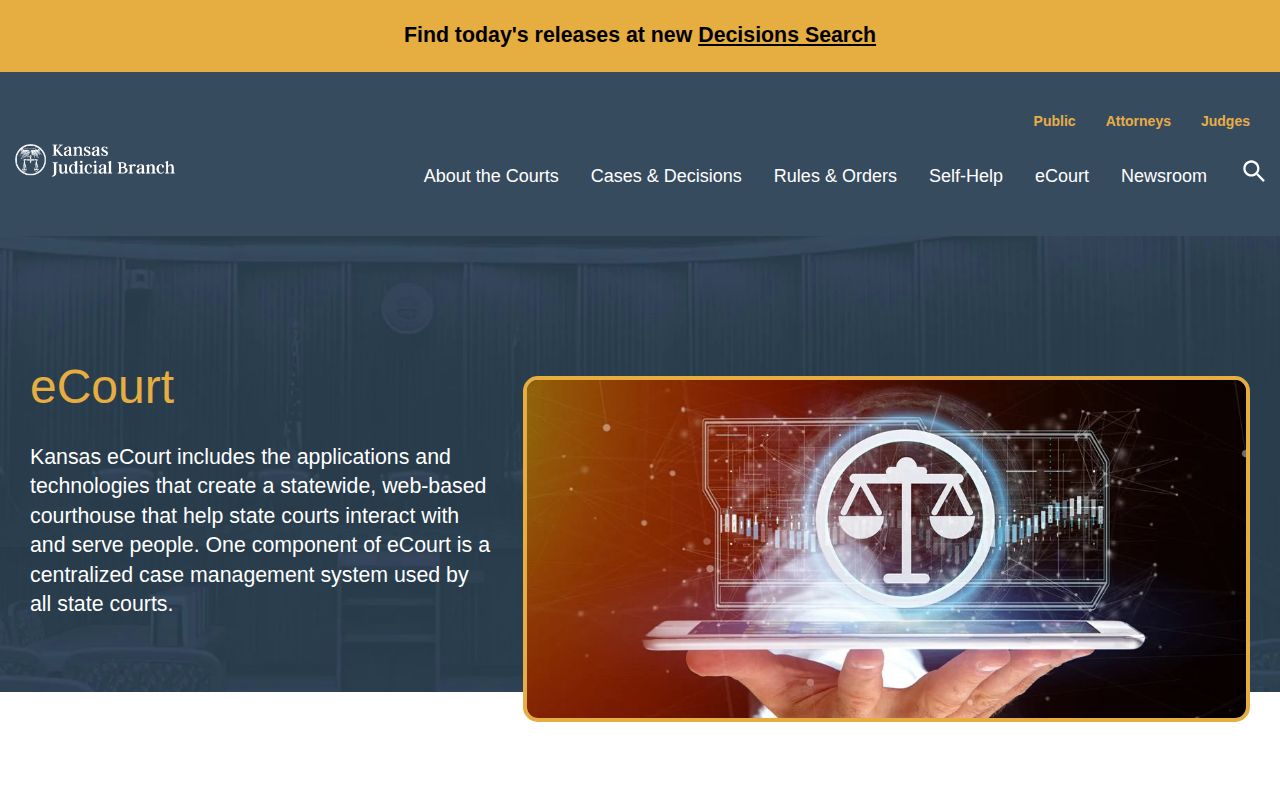
The captured page is an access guide, not proof of any person's release; the case entry and sheriff record still supply that evidence.
Anderson Court Document Meanings
A bond order generally authorizes release pending further proceedings; it is not a case dismissal. An own-recognizance order permits release without a cash bond under the terms the court states. A journal entry of judgment records the formal disposition and sentence. “Time served” means the sentence was satisfied as ordered or calculated. Probation places the person in the community under court-linked supervision rather than proving release from a KDOC prison.
A commitment or mittimus can explain why someone left Anderson County Jail but entered state custody. That event is a transfer, not community release. KASPER becomes the public state locator after KDOC accepts and records the person. A revocation can change a community placement back to custody. A satisfaction or discharge entry may mark the end of a court obligation, but it should not be extended to unrelated cases.
| Court item | Release meaning |
|---|---|
| Bond order | Authority for release while the case continues |
| Dismissal | End of the stated charge or case, subject to other holds |
| Probation order | Community supervision under court authority |
| Commitment | Transfer into KDOC custody |
| Revocation | Possible return from community placement to custody |
Anderson Court Records Access
The official Fourth Judicial District page identifies the district serving Anderson County. Research did not confirm a separate court mailing address, phone number, public-counter schedule, or copying fee suitable for publication on this page. Use the current district page and portal instructions to confirm those details before a visit rather than importing information from another county in the district.
Fourth Judicial District
Service: Kansas state district court for Anderson County
District page: Fourth Judicial District
Online search: Kansas District Court Public Access Portal
In-person route: Public courthouse terminal and clerk access, subject to current rules.
Ask for a specific filed item by case number and document name. If legal reliance matters, ask the clerk whether a certified copy is available. Do not ask the clerk to interpret the order or predict a release date. The signed entry speaks for the court, while the sheriff or receiving agency confirms whether physical custody changed.
Anderson Court Access Limits
Not every public record appears online. Electronic availability depends on access rules and when a court began using the eCourt system. Kansas Courts identifies sealed cases, expunged criminal records, adoption matters, many juvenile and child-in-need-of-care records, grand-jury material, and certain investigative records as unavailable to the public. A portal no-result may therefore reflect restricted access, an identifier mismatch, or an older record rather than proof that no case exists.
Expungement under K.S.A. 21-6614 is a judicial process with eligibility and timing rules. It is not automatic when a person leaves jail. When an order is granted, the public portal should not be expected to return the expunged case. The signed order and the governing statute determine its effect; an old screenshot or newspaper item is not a substitute.
Anderson Court Probation Records
Probation and post-prison release are often confused. A district-court probation order can place a person in the community without any KDOC prison release. Court Services and Fourth Judicial District Community Corrections supervise qualifying local court placements. KDOC Parole Services supervises parole and postrelease after state incarceration. The order and supervising office identify which path applies.
KASPER cannot currently display community-corrections events after April 21, 2021 because of its modernization gap. A sparse or old KASPER timeline is not proof that Anderson County probation ended. Use the current court docket and Garnett community-corrections contact for that category. Use KASPER and KDOC Parole Services for state-prison supervision.
Verify Anderson Court Release Timing
Compare the court entry with the agency that carried it out. The sheriff can provide the booking-end timestamp and disposition. Kansas VINE can corroborate a county-jail custody change but is neither a certified record nor a complete historical archive. KASPER can show a later KDOC location, parole, postrelease, or discharge status. A federal or ICE transfer requires the federal locator named in the movement record.
Different timestamps can all be correct. The judge may sign an order before jail staff complete processing. A receiving agency may post its record on a later working day. Keep each date with its source and label. If two records conflict, ask the office that created the disputed event rather than forcing the entries into one unsupported timeline.
The sound proof set for an Anderson County Jail exit is the sheriff release or transfer record plus the district-court order. It shows both physical custody and legal authority. Verify volatile status at the source, preserve the access date, and avoid drawing a broader conclusion than the particular case and custody event support.