
Anderson County Three-Day Release Records
The official Anderson County Sheriff page and county navigation do not provide a 72-hour recent-release tab, searchable archive, update schedule, or retention statement. The county does state that the sheriff maintains the jail roster and activity reports. A narrow request for an existing three-day release log is therefore the accurate local route.
A three-day range is useful for catching events that occurred between checks. It does not cure all timing issues. A court order can precede physical release, a jail entry may post after processing, and VINE depends on the agency data transmission. Ask for the actual start and end timestamps rather than using a vague phrase such as “over the weekend.”
The matching Kansas Open Records Act policy capture appears below.
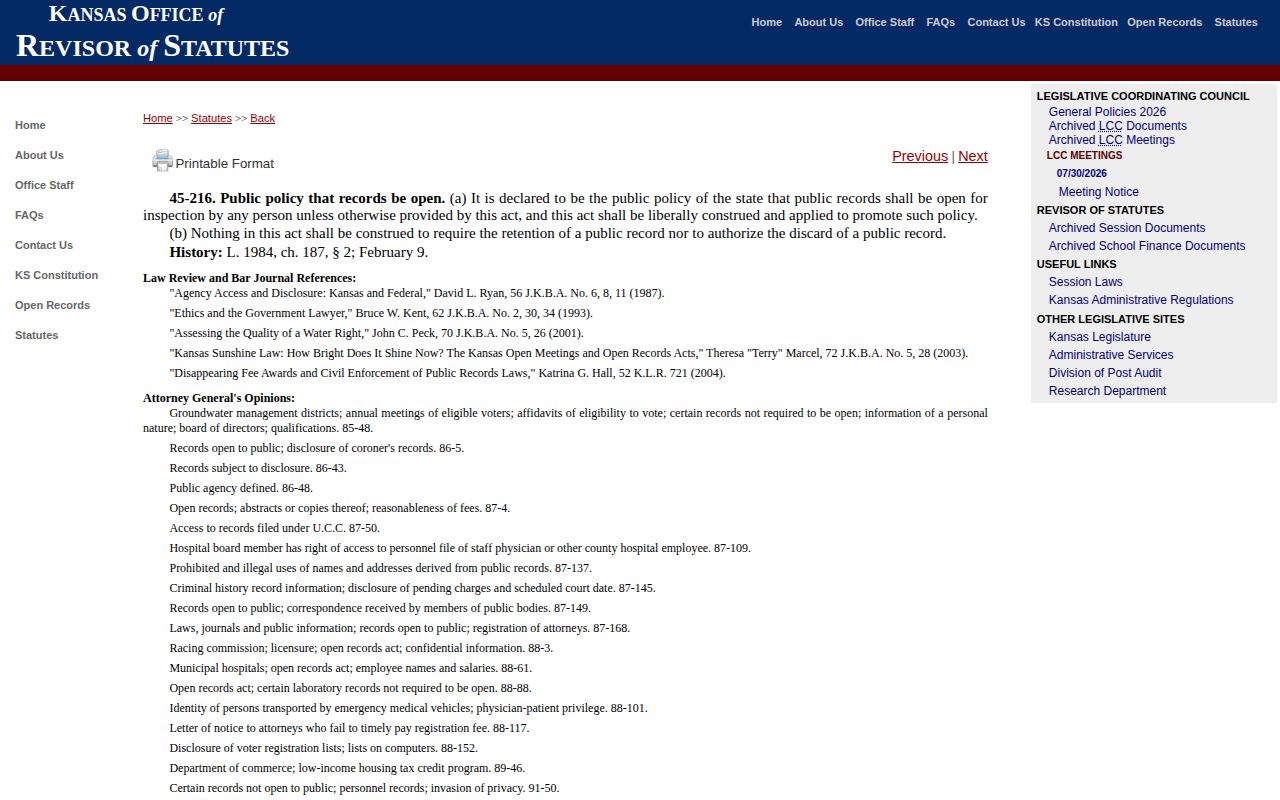
That policy supports access to public records while leaving exemptions and record-specific decisions in place.
Check Anderson County 72-Hour Releases
Contact the Anderson County Sheriff’s Office at 135 E. Fifth Ave., Garnett, KS 66032, or call 785-448-5678. Because no records hours, fixed fee schedule, or online submission form was verified, call before visiting. Ask whether staff can provide an existing jail register, release log, or activity report for the exact range.
- Choose an exact 72-hour start and end time, including dates.
- Ask whether an existing sheriff record lists releases or transfers in that range.
- Supply a name or booking identifier if the inquiry concerns one person.
- Request release time, disposition, and receiving agency fields if they exist.
- Check the legal basis in the Anderson County court file and confirm transfers with the receiving agency.
The Anderson County 24-hour release process is a better fit for same-day monitoring. The three-day method should not be shortened by simply looking at a current roster, since a roster is only a custody snapshot.
Anderson County 72-Hour Fields
No official feed defines standard columns. These are the most useful existing-record fields to request. The sheriff may hold some, all, or none in a given document, and KORA does not require a new custom report.
| Field | Why it matters |
|---|---|
| Name and booking number | Separates people with similar names and links the jail episode. |
| Booking date | Distinguishes an older hold from a new booking. |
| Release date and time | Places the movement within the three-day range. |
| Disposition or release type | May show bond, time served, court order, or transfer. |
| Destination | Identifies another custodian when the person did not enter the community. |
Do not fill gaps with guesses. If the record only shows that Anderson County custody ended, describe that limited fact. A later KASPER, BOP, ICE, or other-jail record may show where custody continued.
Anderson County Weekend Release Checks
No Anderson County weekend-release schedule or special holiday policy was found in the official material. Do not claim that releases occur at a set hour or roll automatically to a business day. The value of a 72-hour request is simpler: it spans more than one calendar day and can include events missed between office contacts.
Use event time, not publication time. A weekly paper, court docket update, or VINE notice may appear after the physical jail movement. The sheriff’s release field documents the movement; the signed court order documents its legal authority. If those times differ, preserve both and explain what each source records.
For a specific person, the Anderson County release-record search routes the inquiry by custodian. That matters when a three-day jail record says “transferred” rather than released to the community.
Obtain Anderson County Release Logs
Address a Kansas Open Records Act request to the sheriff. Seek existing records, such as the “jail release log, jail-register release entries, and public release-date/time and disposition fields” for a defined 72-hour range. Ask for electronic copies and a fee estimate. If a part is denied, request the written legal basis for the withholding or redaction.
K.S.A. 45-218 covers inspection, copies, office access, and fees. K.S.A. 45-221 lists records that may be exempt. The statute does not turn a non-existent online feed into a required custom report. A focused request makes it easier for the custodian to locate a real source record.
The exemption statute is shown in the matching Kansas records-law capture.
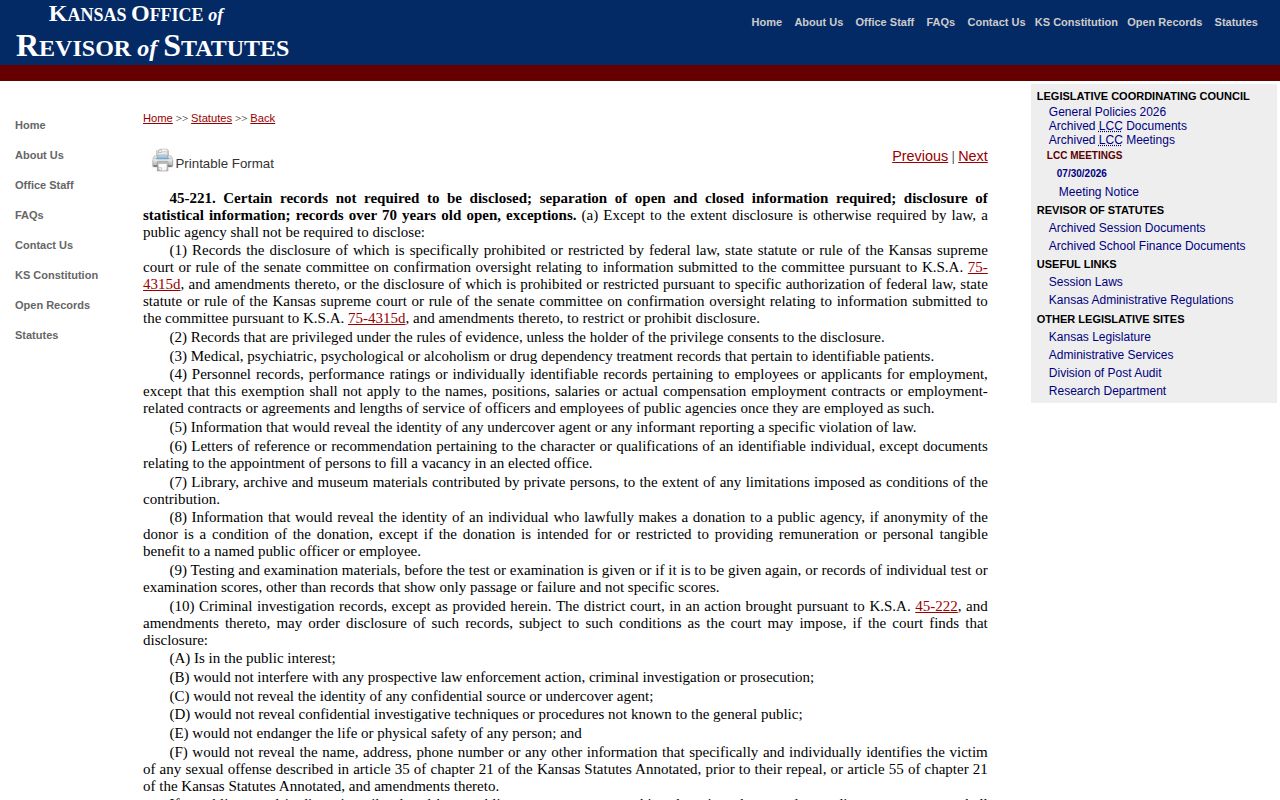
The image underscores why a public-record request can return redacted material rather than every field sought.
Anderson County Release Retention Gap
The county publishes no online retention period for recent-release data. That is important. A person should not expect a three-day view to remain searchable after the window, and no archive should be promised. Ask the sheriff which existing activity or jail records cover the dates and how far back those records can be retrieved.
A no-result has bounded meanings. The name may be misspelled, an alias may have been used, the range may be wrong, a record may be restricted, another agency may be the custodian, or no matching release may exist. Absence alone does not choose among those explanations.
Note: State what the source returned and when it was checked; never convert silence into a release claim.
Anderson County Roster Snapshot Limits
Dated Anderson County Review material has published jail-roster snapshots and activity reports. It is local context, but it is not a proven official 72-hour release dataset. Names and booking dates in a snapshot show who was listed as of publication. They do not provide a full release date, reason, or transfer destination.
A combined count of people “booked and/or released” cannot be reported as a release count. The two event types are not separated. The paper’s weekly cadence also creates lag, so a person can move through custody between editions. Confirm person-level facts through the sheriff and district court.
The phrase “JAIL FARM-INS” and listings of holds for other counties appear in local material, but no official definition was found. Do not infer a custody outcome from that phrase. It does show why movement off an Anderson County snapshot may reflect interagency handling rather than community release.
Verify Anderson County Release Outcomes
Kansas VINE can corroborate a county jail custody change and provide notification for one person. It does not include KDOC prison residents. KASPER is the next source when the sheriff record identifies a state transfer. For federal custody, use the BOP locator. If the sheriff says “released to ICE,” use the ICE locator and treat the event as a transfer.
| Outcome | Verification source |
|---|---|
| County community release | Sheriff release record and district court order. |
| KDOC transfer or later prison release | KASPER and KDOC confirmation. |
| Federal transfer or release | BOP locator and federal court record. |
| ICE transfer | Sheriff disposition and ICE locator. |
A court order can authorize release before the person leaves the jail. A VINE event can post later. Report those as separate facts until the sheriff confirms physical departure. This method protects the meaning of the wider three-day window.
Note: “Transferred” ends one agency’s custody but does not mean the person is free from all custody.
Public Record Search
Sponsored Results