
Understanding Anderson County Released Inmates
The Anderson County Sheriff's Office operates the local jail and maintains its jail roster and activity reports. Once a person leaves that custody, the current roster is no longer the right historical record. The sheriff's booking or release entry documents the physical movement, while the Anderson County District Court file can show the legal authority behind it. Those records answer different questions and may carry different timestamps.
“Released” is not one outcome. Bond, recognizance, dismissal, time served, a completed jail term, or a probation order can place someone in the community. A commitment to a Kansas prison, another county's warrant, a federal writ, or an immigration detainer can move the person into another agency's custody. Parole and postrelease supervision mean the person is outside a KDOC institution but remains supervised. Sentence discharge is different again because it marks the end of the identified corrections obligation.
Core rule: a name missing from a current roster proves only that the person was not shown there when checked. Confirm release or transfer through the movement record, court order, or receiving agency.
How Anderson County Jail Exits Work
The legal and physical records should be read together. A judge can authorize release before jail staff finish processing it. Conversely, a jail movement can document a transfer that is not obvious from the docket's short event description. Ask for the agency's exact disposition wording rather than replacing it with a broad label.
| Exit type | Meaning | Best next record |
|---|---|---|
| Bond or recognizance | Community release while the case continues | Bond order, jail release entry, court docket |
| Dismissal or time served | The charge or custody basis ended as recorded | Journal entry and release record |
| Probation | Community sentence supervised by Court Services or community corrections | Sentencing order and supervising office |
| KDOC commitment | Transfer from county custody to the state prison system | KASPER and KDOC records |
| Other hold or writ | Transfer to another county, federal agency, or possibly ICE | Sheriff disposition and receiving-agency locator |
No official Anderson County page reviewed states a regular release hour, property-return procedure, transportation arrangement, or public release fee. Those gaps should remain gaps. Call the sheriff before relying on logistical assumptions.
What Anderson County Release Records Show
An existing jail register entry or booking-and-release record may connect the custody exit to the correct person and booking. Anderson County does not publish a verified online field dictionary, so request the fields needed and let the custodian identify what exists or must be withheld.
| Requested field | What it can establish |
|---|---|
| Name, alias, date of birth | Identity matching and separation from similar names |
| Booking number and booking time | The particular custody episode |
| Release date and time | When jail processing recorded the exit |
| Release disposition or destination | Community release versus transfer, if maintained and public |
| Charges, bond, arresting agency | Context tying the booking to a case or order |
| Booking photograph | The image linked to that booking, subject to the custodian's KORA review |
The court's journal entry, bond order, disposition, sentence, probation order, or commitment is often the more durable explanation. It does not always prove the moment of physical departure. For legal reliance, ask whether the sheriff offers a certified or custodian-authenticated copy and obtain the relevant court record separately.
Request Anderson County Release Records
Begin with the Anderson County Sheriff's Office at 135 E. Fifth Ave., Garnett, KS 66032, telephone 785-448-5678. The reviewed county pages do not publish a dedicated release-record form, fee schedule, office hours, response timetable, or retention period. Call first for the current custodian and accepted submission method.
- Identify the person with a full name, aliases if known, date of birth, and an approximate booking range.
- Ask under the Kansas Open Records Act for an existing “booking/release record, jail register entry, release date and time, disposition fields, and booking photograph” tied to that booking.
- Request electronic copies when available and a cost estimate before chargeable work begins.
- If information is withheld or redacted, ask for the written legal basis and a description of the affected portion.
- For proof of legal authority, match the response to the case number and signed Anderson County District Court order.
135 E. Fifth Ave.
Garnett, KS 66032
785-448-5678
Hours and release-record fees were not published; call before visiting.
Kansas Law for Anderson Release Records
K.S.A. 45-216 states Kansas policy favoring openness of public records unless another law provides otherwise. K.S.A. 45-218 supplies inspection, copying, office-hours, and fee mechanics. It does not require the sheriff to create a custom report that does not already exist. K.S.A. 45-221 lists categories that may be withheld, including records involving investigations, security, privacy, juveniles, and other protected matters.
Kansas court access also reflects court rules, orders, and restrictions. Sealed, expunged, adoption, many juvenile and child-in-need-of-care, grand-jury, and certain investigative records are not publicly available. Expungement under K.S.A. 21-6614 is a judicial process, not an automatic consequence of release. A granted order may change public visibility, but it should not be assumed to erase every independently lawful agency record, registry duty, or publication.
Find a Released Anderson County Inmate
The search begins with custody scope, not a single statewide name box. Anderson County has no verified official rolling release feed, so the complete route uses several official channels.
- Call the sheriff and request the booking/release entry for a recent county-jail exit. The 24-hour release list guide explains the absence of a public same-day feed.
- Check Kansas VINE for a county-jail custody status or alert, but treat a no-result as inconclusive.
- Search the Anderson County District Court case for the bond order, journal entry, disposition, sentence, probation order, or commitment.
- If the person went to state custody, search KASPER and preserve its exact status and date labels. Use the projected release date guide for future dates.
- For federal custody, use the BOP locator. For a possible ICE transfer, use the ICE detainee locator and the sheriff's disposition.
- When databases are silent or conflict, ask the agency that created the event record for confirmation.
A no-result can follow a spelling variation, alias, identifier mismatch, data lag, restricted or expunged material, transfer, or a search outside that system's scope. It is not a safe substitute for a release record.
KDOC Offender Search for Released Inmates
KASPER, the Kansas Adult Supervised Population Electronic Repository, covers KDOC residents and identified supervised populations. It is not a complete Kansas criminal-history database and is not the Anderson County jail roster. Search by the name and KDOC identifier controls offered, then match identity carefully. Read the literal status, location or supervision context, conviction associations, photographs, and dates shown on the detail page.
The KASPER disclaimer says information updates each working day and warns that it can contain errors or omissions. Most importantly for Anderson County, community-corrections events after April 21, 2021 cannot currently display. A timeline that appears to stop there does not prove supervision ended.
The official KASPER entry screen shows the terms users must accept before searching.
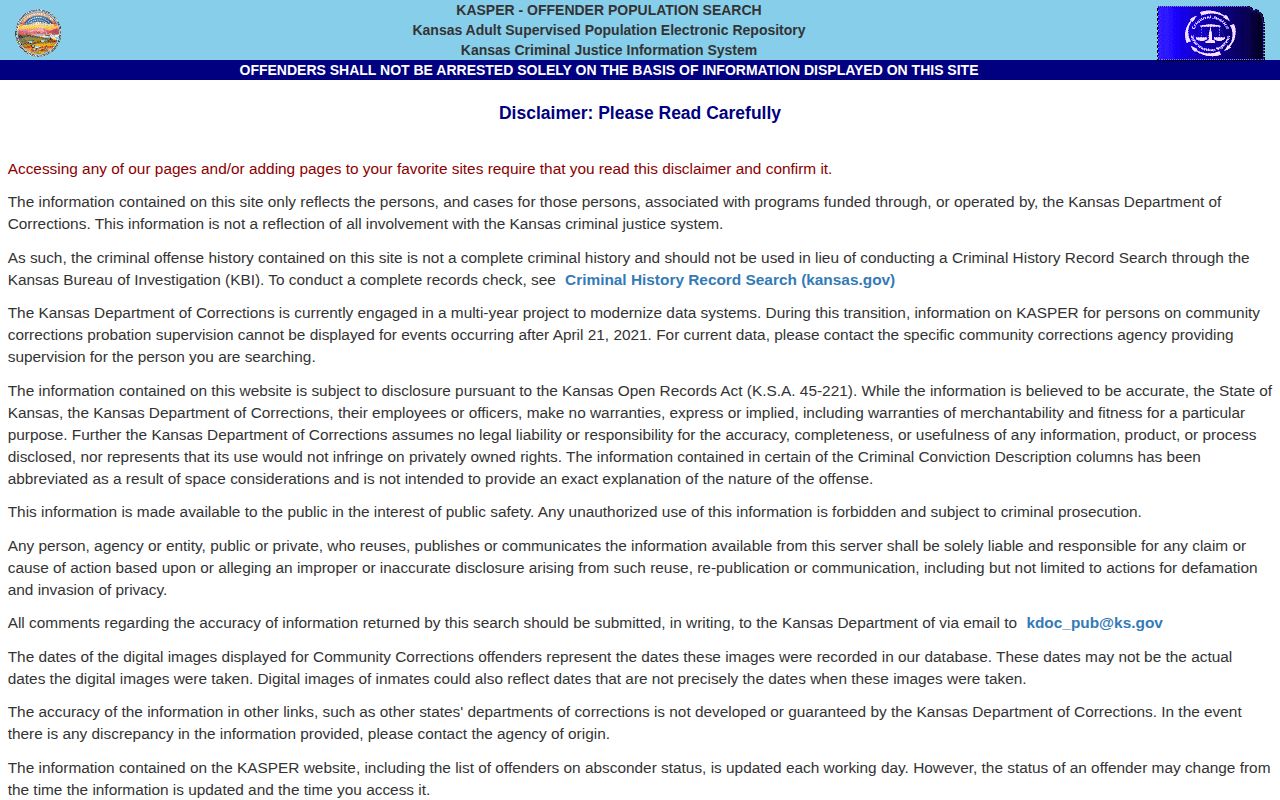
This screen is the appropriate statewide starting point only after a county record or court order indicates KDOC involvement. For a disputed public entry, KDOC lists kdoc_pub@ks.gov for written accuracy comments. Sentence Computation answers person-specific date questions at 785-296-3317.
Anderson County Recent Release Search
No distinct official Anderson County 24-hour or 72-hour release URL, retention statement, verified released-person fields, or sheriff-branded mobile app was found. The county says the sheriff maintains the jail roster and activity reports, which supports a narrow direct request for a defined period. Ask for a release log or booking records covering exact dates rather than requesting an office-created analysis.
The Anderson County Review publishes dated jail-roster and activity material, but those weekly snapshots are not a proven sheriff-operated rolling release archive. A roster “as of” a date shows who was listed then. Even a combined “booked and/or released” total cannot be restated as a release count. Use newspaper material only as a dated lead and verify the person-level event with the sheriff and court.
Verify Anderson Parole and Probation
KDOC Parole Services handles parole and postrelease supervision through the Lawrence Parole Office service path for Anderson County. Court Services and Fourth Judicial District Community Corrections handle forms of court probation. These are not interchangeable. A KASPER parole or postrelease entry supports departure from a KDOC institution under supervision, but it does not mean the sentence has been discharged.
For felony community corrections, read the district-court order and contact the Garnett office because KASPER's post-April 21, 2021 display gap can hide later events. The Anderson County parole and probation guide separates the Lawrence KDOC office from local probation channels and explains how to check an alleged absconder label without relying on an old screenshot.
Anderson Release Alerts and Federal Checks
Kansas VINE through VINELink covers adults housed in participating Kansas county jails and can report custody changes such as release, transfer, or escape. It does not include KDOC prison residents. Registering for an alert while a person is in custody can provide timely notice, but the sheriff's record remains the source for the disposition. The official Kansas materials currently show conflicting toll-free digits, so use the online service and verify the number before publishing or relying on it.
Federal custody requires a different lookup. The BOP Inmate Locator may show “Released” with a release date for federal records generally from 1982 forward. That does not rule out supervised release or another agency's custody. The ICE Online Detainee Locator is a current and recently released detainee locator, not a durable historical archive. A county release to ICE is a transfer, not a community release.
Released or In Custody: Choose the Record
| System | Useful for | Key limit |
|---|---|---|
| Current county roster | People shown in local jail custody now | Dropping off does not prove community release |
| Sheriff release record | Physical county-jail exit, time, disposition | Must often be requested directly |
| Kansas VINE | County-jail custody status and alerts | Does not cover KDOC prisons |
| KASPER | KDOC custody, parole, postrelease, discharge context | Not a county roster or complete criminal history |
| District court | Legal order behind bond, sentence, probation, commitment | Order time and physical movement time can differ |
| BOP or ICE | Federal prison or immigration custody | Separate scope and retention rules |
Anderson County Release Facility Paths
The Anderson County Jail is the local custody starting point. The Anderson County District Court supplies the legal case record. A state commitment moves the search to KDOC institutions statewide, while parole and postrelease route through the Lawrence Parole Office. Local felony probation can involve Fourth Judicial District Community Corrections. County-jail alerts use Kansas VINE. A confirmed federal transfer belongs in the BOP release path.
Which Anderson Court Document Proves Release?
The Kansas court portal separates case information from filed documents. A search result can identify the case, parties, judge, hearing dates, and available events, but the filed journal entry or bond order usually carries more weight than a bare docket line or roster disappearance. Online document availability depends on eCourt timing and access rules. A public courthouse terminal may provide records that are not available remotely.
Use the Kansas Courts district-record guidance to distinguish portal information from courthouse access.
This distinction matters when a person appears to have left the Anderson County Jail: the court record explains legal authority, while the sheriff movement entry documents physical processing. If they conflict, preserve both timestamps and ask each originating office about its own record.